
From the archive
Choose a prime by rehearsing with your kit zoom
Try two focal lengths on ordinary outings before you buy a prime. Compare keepers, space constraints, and what you actually missed.
The Camera Notebook ·
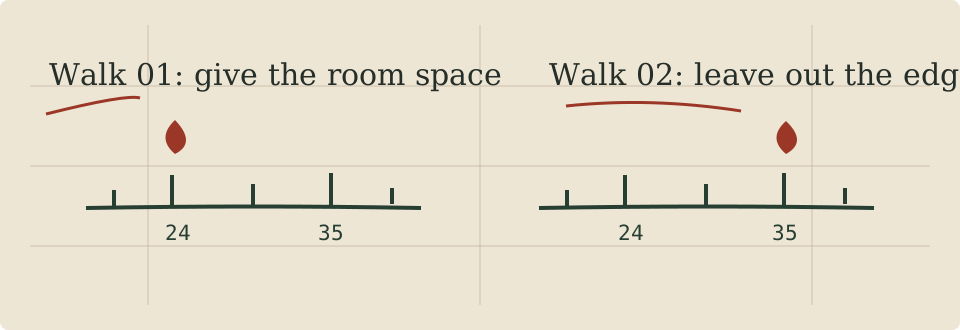
A prime locks in one angle of view. Before you buy one, lock your kit zoom to a setting for a short outing and see what that angle makes easy and difficult. The useful result is a sentence like “I could frame two people across this table at 24 mm, but I needed to back up at 35 mm.”
Choose two settings the zoom already covers
Start at 24 and 35 mm actual on a Nikon DX camera if those markings are on your zoom. With the nominal 1.5× DX framing factor, those approximate 36 and 52.5 mm equivalents. On a full-frame body, 35 and 50 mm are useful trial settings if supported. These pairs are starting points, and they vary with your sensor and mode. Confirm you are comparing the same orientation and normal still-photo crop in both sessions.
Repeat a short route
- Choose two familiar scenes you can repeat, such as a person and their surroundings, and a small object you want to isolate. Pick one zoom setting and leave the ring there for the session. Check the recorded focal length in your photo viewer if it is available; a ring mark is only a guide.
- Return to the same scenes with the second setting. Where possible, include one pair from the same spot and another where you move so the main subject is similarly sized. Keep those groups separate in your notes.
- Compare the pictures you kept and jot down missed frames. Did you run out of space when backing up? Did you wish to leave out more of the surroundings? Did you change position because of the light or because of framing? Record the reason before giving a point to either focal length.
Decide what the exercise did not test
A kit zoom can rehearse that angle. It cannot show how a specific prime focuses, renders blur, or performs wide open. A separate prime might offer a wider maximum aperture than the zoom at the same focal length, but you still need to check its mount, sensor coverage, focus distance and handling. If your chosen fixed length made you miss too many photographs, the zoom may remain the better fit for that job.
As a documented example, Nikon lists a 16–50 mm Z DX kit zoom and a 24 mm Z DX f/1.7 prime. The kit zoom lets you try 24 mm framing on the same DX body before looking at the prime for other reasons. These are examples from Nikon’s specifications, with no hands-on performance claim. Use the lens guide and the three-frame exercise to narrow the choice.