
35 mm and 50 mm are useful reference points
At 35 mm equivalent you can often show a person and the room around them. At 50 mm equivalent you admit less of the room from the same spot. Neither is a rule: a small room may call for something wider and a portrait may work at either if the distance suits the picture. Start in the framing lab and inspect the edges rather than treating a focal length as a style.
Read the barrel, then do the conversion
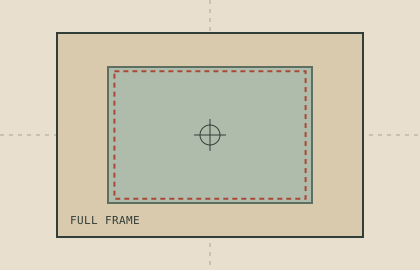
The lens label is the actual focal length, regardless of which sensor you use it with. To compare fields of view on the full-frame reference, multiply actual focal length by crop factor. To shop backward from a desired equivalent, divide by the crop factor. Check the actual model’s specification and mode. See Nikon’s explanation of DX and FX. These are approximate matches; different frame shapes may have different horizontal and vertical coverage.
| Format | 35 mm lens | 50 mm lens |
|---|---|---|
| Full frame | 35 mm eq. | 50 mm eq. |
| 1.5× APS-C | 52.5 mm eq. | 75 mm eq. |
| 1.6× APS-C | 56 mm eq. | 80 mm eq. |
| 2× crop | 70 mm eq. | 100 mm eq. |
For a roughly 35 mm view on 1.5× crop, shop near 23–24 mm actual. On 1.6× crop start near 22 mm; on 2× start near 17–18 mm. Aiming for 50 mm equivalent instead? Start near 33, 31, and 25 mm actual respectively. Choose nearby focal lengths your mount offers, or test the framing with a zoom first.
Choose by scene
- Tables, friends and interiors: Try 24–35 mm equivalent for space and context. If you get very close to faces, compare a position farther back before deciding you dislike a focal length.
- Travel and a walkaround kit: Try a zoom that covers moderate wide and normal angles. For a single prime, practice for a walk at about 35 or 50 mm equivalent and note which edges you struggle to include or exclude.
- Head and shoulder portraits: If the room gives you space, try roughly 70–85 mm equivalent and choose your position for the face. Keep the background at a useful distance if you want it less distinct.
- Sports or wildlife from a fixed spot: Borrow a longer zoom to learn how much reach and handling you really need. Check minimum focus, field of view at your distance and how well you can follow movement.
Turn a desired view into a real lens check
Suppose you like a roughly 35 mm full-frame-equivalent view and your camera has a 1.5× crop factor. Divide 35 by 1.5: the starting point is about 23 mm actual focal length. A 24 mm lens on that body gives roughly a 36 mm equivalent view. That is a framing comparison, not a statement that both cameras produce the same depth of field or image quality. Nikon illustrates the 24 mm example in its DX and FX format guide, checked 18 November 2026.
Next check the exact body’s mount and the lens’s image-circle coverage, autofocus and stabilization support. An adapter may change which functions work; consult the body, adapter and lens documentation together. If a specification is missing, leave compatibility unresolved and ask the manufacturer or seller. A calculated field of view is not evidence that a lens physically fits.
Prime or zoom?
A prime has a fixed focal length; a zoom gives you multiple angles without changing lenses. Compare the specific lenses for size and maximum aperture. A wide maximum aperture can make a faster shutter possible in low light at the same ISO and can help narrow depth of field. Crop-factor equivalence by itself does not predict blur, light transmission, sharpness or autofocus.
Try the kit-zoom rehearsal before shopping
See gear and reading examples · Check sources and assumptions